
The Less Thinking, More Doing Program, The Sequel: Slightly More Thinking, Slightly More Doing

April 30th, 2010  |  Published in Workout ideas  |  23 Comments

The Less Thinking, More Doing Starter Program was unveiled to wild enthusiasm from Stumpfans. Now Geoff Girvitz is back with more asskicking glory. It’s LTMD: The Sequel: Slightly More Thinking, Slightly More Doing.

This is a simple program. It’s easy to understand and easy to follow – just a bit less so than the original one, which you’ll find here.
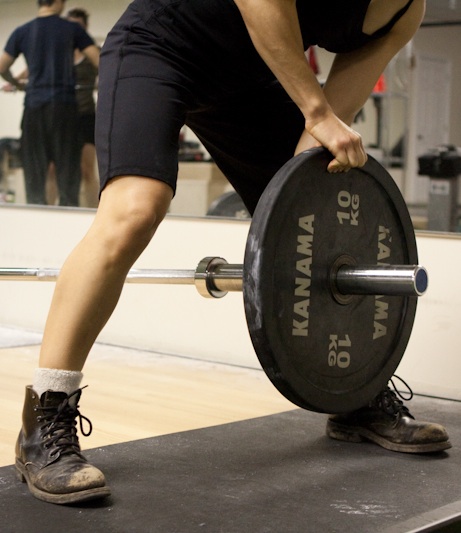

putting-on-weight-plate-modThe purpose of the original LTMD Program was to provide an antidote for those of you paralyzed by too much information. The purpose of Phase II is to help you keep you moving forward while you continue to learn. As long as you’re familiar with the exercises, it’s something you can print out a copy of and bring to the gym with you right now.

Working out can be quite simple. You need only follow these three steps:

  1. Show up: consistency is more important than anything else
  2. Work hard: don’t half-ass things
  3. Don’t do anything stupid: skip anything wildly inefficient and always weigh risk with reward

While optimizing the efficiency of your workouts is an inevitable goal, it represents perhaps the last 10-20% of your journey. You can choose a program that isn’t great and still walk away with an A in results. Just follow the three steps above.

Let’s divide up duties: your job is to show up and work hard. My job is to give you a program that minimizes injury risks and makes good use of your time. Good? Good. Let’s get to work.

Part 1: Soft tissue

Grab a foam roller. If you don’t have a foam roller, use a medicine ball, aluminum bottle, a rolling pin, or anything else that will let you regulate pressure. Roll it along your body (or your body along it). Hit the following:

  • The sides of your legs (between knee and thigh)
  • Your quads and hip flexors (knee to hip)
  • The inside of your thighs (by the knees and by the groin)
  • Your bum
  • Your upper back
  • Your lats
  • Whatever else feels tender

Give each area 8-12 passes. Each spot should take no more than a minute. If there’s a problem area, frequency is the key, not duration. If something’s bugging you, hit it again in an hour.

Part 2: Stretching

Pick the two tightest parts of your body and stretch them. The odds are strongly against these being any part of your back. However they are likely to be the:

  • Front of your shoulder and pecs
  • Hamstrings
  • Hip flexors
  • Glutes

Don’t force anything and only look at range of motion through the joint you’re stretching. Rounding your back out until you look like a hedgehog will not give you more flexible hamstrings; it will give you a bad back.

Some people consider it heretical to perform any static stretching before a workout. Ask them for links to the relevant journal articles. If they can actually name some, read them and draw your own conclusions.

Part 3: Warm-up

Spend 5-10 minutes practicing light versions of the movements you’re going to use during the strength training portion of your program. Those movements might be:

  • Glute bridges
  • X-band walks
  • Reaching to the sky
  • Bodyweight split squats
  • Scapular push-ups
  • Regular or knee push-ups
  • Running forward
  • Running backward
  • Skipping sideways
  • Crawling around like a ninja

Remember that the objective is not to fatigue yourself, but to prepare your body for the more intense exercise to come.

Part 4: Loading

It should feel as if you can perform one or two more reps in each set (maintaining good technique throughout) than the number prescribed. If you’re not finishing the set, you obviously selected too heavy a weight. However, if you’re finishing the set, you may be overestimating how difficult things felt. For that reason you will periodically choose one (and only one) exercise and go to failure.

Failure means not being able to perform another rep. Not for a $100,000 cash prize. Not to scare away an axe wielding maniac. That’s how you’ll know.

Naturally, you will want to take whatever precautions necessary to ensure that you don’t get hurt if you’re unable to move the weight from Point A to Point B (refer to Step 3).

Part 5: The exercises

Day 1 Day 2
Circuit 1:

A1 1-leg Romanian deadlift (reach overhead)

A2 Seated cable row

A3 Dumbbell bench press

4 sets of 8, rest 60 sec between circuits

Circuit 2:

B1 Goblet squat

B2 1-arm cable pulldown

B3 Plank on forearms

2-3 sets of 15, rest as needed

Circuit 1:

A1 Split squat

A2 Pull-down

A3 Overhead press

4 sets of 8, rest 60 sec between circuits

Circuit 2:

B1 Low cable RDL

B2 Bench dumbbell row

B3 Side plank

2-3 sets of 15, rest as needed

Letters denote a series. For example, on Day 1 you will perform the A exercises in the order above. You will rest 60 seconds after each circuit. You will repeat this three times before going through the B exercises – again resting for 60 seconds between your first and second sequence. Within the circuit (i.e. from exercise A1 to A2), rest as little as possible. If you’re going to upchuck, of course take a moment. But push yourself — within reason — to take care of business without too much lollygagging.

Part 6: Intervals

After you finish your strength training, you’ll seal the deal with some conditioning. Intervals may not be easy but they are simple, quick and highly effective. If done properly, they will also be the most difficult 15-20 minutes of your life – every time you do them.

Here’s what you need to do:

  • Choose an exercise that you can perform safely at a relatively high intensity.
    I recommend a stationary bike. Swimming is ideal for many reasons but pool access is rarely convenient enough. A step mill will be fine and dandy. An elliptical machine will not be. I don’t recommend running unless you’ve already been coached or hail from Kenya. Few of us are sufficiently good natural runners. If you’re really de-conditioned, something as simple as walking fast and/or uphill may be fine.
  • Experiment with whatever level of intensity you can safely handle.
    Seek good medical advice (not to be confused with listening to any old MD) if you have any cause to be concerned. In a healthy person, 90% of maximal heart rate is considered to be a good goal. If you don’t have a heart rate monitor, then you will have to go by your own sense of difficulty. Take it easy on your first few days. Move into things progressively. Be careful.
  • Once you have figured out your own parameters for safe exercise, push them for one minute.
    One single minute and no more. You will do this four or five times.
  • In between your high intensity minutes, drop your pace as much as you need to in order to recover for your next round.
    Beginners may find they need several minutes to recover. Others may find less than one minute to be adequate. Remember that the effectiveness of this style of training has very little to do with how hard you go during your breaks. Don’t get suckered into thinking that more time at a lower intensity will be more effective. It won’t.

Part 7: Post work-out

Take a few minutes to cool down. You can and should repeat the stretches and soft tissue work from the beginning of this program.

Part 8: The big picture

You will get far more out of this program with proper nutrition. Refer to Stumptuous, Kyle Byron or Precision Nutrition for more information on what (and when) to eat.

This program will serve most people well for four weeks or so. I would recommend using it 2-3 times per week. You’ll simply alternate between Day 1 and Day 2, regardless of your training frequency.

Every time you revisit a day you will try to do better than the last. Before you try to up your weight, try to improve your technique. You may have noticed that doing things right is usually more difficult than doing them poorly; the same goes for lifting weights.


geoff_girvitz_headshotGeoff Girvitz runs Bang Fitness in Toronto. He puts HGH in his smoothies and once punched Flex Wheeler in the soleus.

Responses

  1. Ingerid says:

    May 2nd, 2010at 1:50 pm(#)

    YAAAAAAY!

    Thanks. I have been waiting for this. :D

  2. Jill says:

    May 6th, 2010at 8:58 am(#)

    Thank you so mucn for this sequel.
    Since my gym is usually so crowded that it won’t be possible to do any kind of circuit because the equipment can’t be hogged even for that short time, would it be completely useless to do the exercises as straight sets?

  3. Geoff says:

    May 6th, 2010at 2:14 pm(#)

    Straight sets won’t kill you, but they’ll make your workouts far less efficient.

    If you’re going to be successful in a crowded gym, you’re always going to need a couple of alternatives in your back pocket.

    Forget about the specifics of the exercises for a moment and look at the movements.

    Here is a list of exercises with alternatives for the equipment-deprived:

    Seated cable row – Inverted row – Seated cable row

    Dumbbell bench press – Push-up (elevate your upper body to make these easier)

    1-arm cable pulldown – 1-arm band pulldown

    Pull-down – Jump to pull-up – band pull-down

    Low cable RDL – Dumbbell RDL

    Everything else should be easy to pull off, provided that dumbbells are available.

  4. Rachel K-G says:

    May 8th, 2010at 2:43 pm(#)

    Why do you recommend against ellipticals for interval training? (I may fall under the “really deconditioned” heading, but the elliptical certainly brings my heart rate right up…)

  5. Mandy says:

    May 9th, 2010at 11:27 am(#)

    Can you talk more about choosing one exercise and going to failure? How often, and how do you choose which exercise? Do you just do one set to failure? I love your articles, please keep writing them!

  6. Geoff says:

    May 10th, 2010at 3:54 pm(#)

    Why do I recommend against ellipticals? I’m sure they can elevate heart rate in most people but, then again, so can tax season.

    The issue is one of function. This is an oft-abused word but it basically refers to being able to transition some of that hard work into the world outside the gym. Is a stationary bike better? I would argue yes if, for no other reason, that you may someday ride a bike outdoors.

    We also know that there are some issues associated with keeping your joints in a fixed track that may not be exactly the way your body was designed to move. It’s one of those slight biomechanical issues that becomes magnified by repetition. In other words, it may eff up your hips. Again, a bike may not be perfect, but it’s an adjustable improvement.

    As far as going to failure goes, I wouldn’t really advocate going to failure at all if it weren’t for one thing: I want you to be really sure of what you’re capable of. This is a measuring stick and not to be confused with a training method. The idea is to use it as minimally as possible and still be honest with yourself. Mileage may vary.

    P.S. thanks, Mandy!

  7. Lauren says:

    May 11th, 2010at 7:57 am(#)

    Great timing on this, I need to switch up my routine! I have a few questions on the exercises though, an explanation or link to a video would be much appreciated. Specifically, how do you perform a 1-leg romanian deadlift with an overhead reach? And what is an RDL? Thank you!

  8. Geoff says:

    May 11th, 2010at 10:28 am(#)

    1 leg vs. 2
    RDL = Romanian deadlift

    Here’s a 1-leg RDL
    http://www.youtube.com/watch?v=hWLg7MrA9y4
    Instead of holding a dumbbell, you’re going to take a med ball or light weight and press it as far away from your head as possible during the descent..

  9. Lauren says:

    May 11th, 2010at 3:08 pm(#)

    RDL=Romanian deadlift! Duh! Thank you! I feel a little dumb for asking, but happy because I like RDL’s a lot. Thanks!

  10. Rachel K-G says:

    May 12th, 2010at 10:12 am(#)

    Thanks for the answer. My hips are occasionally cranky anyway (loose ligaments), so effing with them is the last thing I want.

    I really appreciate the way this program gets a lot of work in with a minimum of fussing with equipment and waiting around for muscles to recover. Thanks again.

  11. Lynne says:

    May 26th, 2010at 10:48 am(#)

    I am a beginner working out at home with a weight bench, db’s and a small olympic weight set. Are there any particular exercises that would be best to substitute in for the cable exercises, or would rows be okay?

  12. Geoff says:

    May 26th, 2010at 3:57 pm(#)

    Dumbbell rows will work nicely in place of seated rows.

    An Olympic bar can also be used for RDLs without too much additional strife. I like to start people on cables because it’s easier to feel your way through the movement but this is ultimately where you’ll want to take things.

    The 1-arm pull-downs are tough to replicate with a pull-down bar but off-set pull-downs or 1-arms with a resistance band should cover you.

  13. Amy C says:

    June 29th, 2010at 10:00 am(#)

    Hi Geoff,

    Thanks for the program!

    I definitely want to get into traditional (back squats). I don’t have any pain or issues but do want to make sure things stay that way.

    Should I perform goblet squats or go right into back squats?

    I have a copy of Starting Strength as a reference source and am feeling pretty good about it. Please let me know your thoughts.

  14. Geoff says:

    June 29th, 2010at 3:48 pm(#)

    We almost always start people on goblet squats because it’s such a great opportunity to learn what neutral spine feels like. You get a bit of assistance by being able to counter-balance with the dumbbell so you can actually sit more vertically (and counter lumbar rounding better) than a conventional squat would allow.

    Two notes:
    1. vertical /= over-arched
    2. you’ll find it more helpful to begin pushing the dumbbell away from you during the bottom half of the movement.

    With that as a base, conventional squatting will come along with more ease (and better form). Good luck!

  15. Julia says:

    July 13th, 2010at 6:44 pm(#)

    Hi Geoff,

    Hmm…I am a little bit confused. So we perform the first circuit 1 ‘A’ three times, do I also perform Circuit 2 ‘B’ three times?

    thanks

  16. Brendan says:

    July 13th, 2010at 7:17 pm(#)

    Hi,

    This is a really interesting approach to training, I like the look of it, but as its clearly been designed for females especially, are there any basic changes one could make to make it a workout suitable for an intermediate male?

    More weight less reps?

    Thanks…

    P.S. maybe there is a website angled a bit like this one but for guys? That would be good…

  17. Geoff says:

    July 16th, 2010at 4:06 pm(#)

    Julia,

    The set numbers

    Circuit 1
    4 sets of 8, rest 60 sec between circuits

    Circuit 2
    2-3 sets of 15, rest as needed

    So . . . A1, A2, A3, repeat . . .

  18. Geoff says:

    July 16th, 2010at 4:09 pm(#)

    Brendan,

    How can you tell this program has been designed for females?

  19. Simma says:

    July 18th, 2010at 8:40 pm(#)

    Brendan,

    I also don’t understand why you think this program is for “females”. A strength coach that claims that women need a different kind of program from men should be regarded with skepticism. Geoff clearly states that this is a program for beginners. The reason this program is unsuitable for you is because you are not a beginner, not because you are “male”.

  20. Brendan says:

    July 21st, 2010at 2:36 am(#)

    It’s more the general context of the website than anything, I take your point that nithing was written that made that point explicitly… so when I said clearly… I was was clearly wrong to do so.

    I have actually done some programs from this site before, and clearly there is no physiological epidement or harm in doing so, in fact I thought they were great, and challenging. But somehow not aimed at the fitness goals most guys have… which may, in fact, be the problem of most guys…

  21. Simma says:

    July 21st, 2010at 9:06 pm(#)

    Brendan,

    Krista’s website is designed to counteract stereotypes about women and fitness. The advice here is not designed to cater to the crappy bill of goods sold to women by the fitness industry. If anything, advice here is about throwing out the whole ”flat tummy and toned butt” nonsense and cultivating functional strength and health.

    Because of that, the advice here ultimately works just as well for men, who merely have a different set of manufactured, counterproductive, and dysfunctional fitness goals sold to them (i.e., sixpack abs, and hyooge pecs and biceps). It’s just a matter of scaling the weight and adaptation curve, which are, anyway, highly individual matters that vary just as much within each sex as between the sexes.

    As it turns out, the routes to achieving functional strength and fitness don’t differ significantly between men and women. While this site addresses women (mostly because there isn’t much out there that encourages productive training for women), and provides an outlet for women- and girl-specific concerns (pregnancy, body image, etc.), the programming and exercises are pretty much applicable to anyone.

  22. Sara says:

    July 29th, 2010at 12:28 pm(#)

    Geoff,

    Could you please clarify a couple of things for me? First, are you suggesting we do 15 reps of planks or hold them for a certain amount of time (this is the only way I know to do them)? Also, I’m assuming for side planks that we cover both the R and L sides??

    Thank you for the workout!

  23. Geoff Girvitz says:

    July 30th, 2010at 8:51 am(#)

    Good questions.

    Don’t worry about reps for planks, go for time. We usually start beginners off with a minute (even if they have to take a couple of short breaks). We’ll make the movement more difficult instead of adding time.

    And yes, side planks (30 seconds is our starting point) on both sides.

    Have fun!

Leave a Response